Tele-Robotic Surgery: Inside Nigeria’s Historic 500km Operation
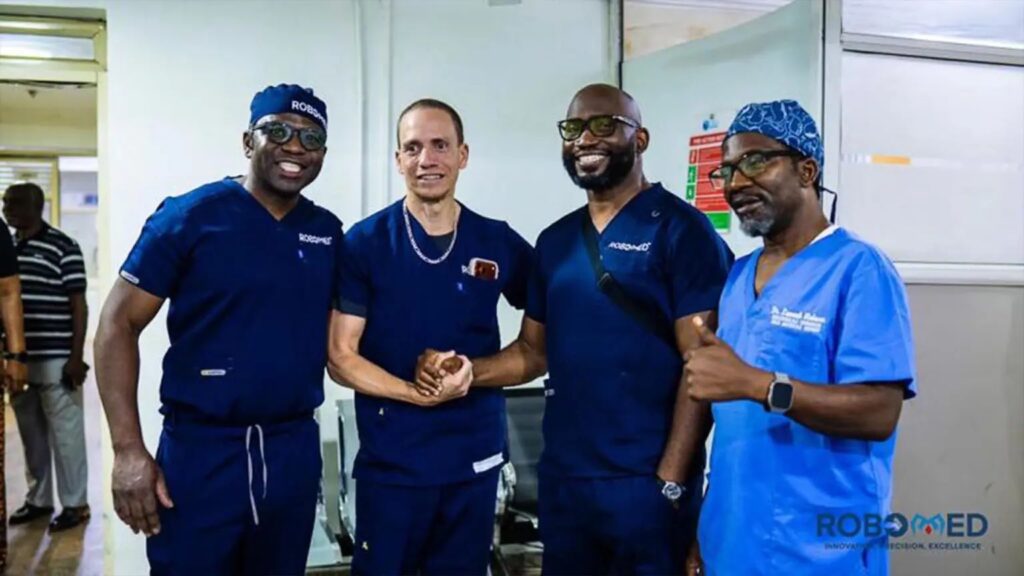
Nigeria has recorded its first tele-robotic surgery. On Saturday, 19 September 2026, a surgeon at Redeemer’s Health Village in Mowe, Ogun State, operated remotely on a patient at Nisa Premier Hospital in Abuja, about 500 kilometres away, removing a kidney affected by a cancerous tumour. The organisers have described it as the first telesurgery in West Africa. What Happened in Nigeria’s First Tele-Robotic Surgery The surgery was performed in real time from a Toumai robotic console at Redeemer’s Health Village on a patient at Nisa Premier Hospital. The procedure was a robot-assisted right radical nephrectomy, an operation to remove a kidney, in this case one affected by a cancerous tumour. It was led by Professor Obi Ekwenna-Davis, a professor of urology and transplantation and co-founder of RoboMed Global. He controlled the robotic system from the console in Ogun State while the patient remained in Abuja. Before the operation, he told journalists that he would be able to operate as if the patient were sitting next to him. The operation lasted about three hours, with brief pauses to check that the equipment and systems were working properly. After the procedure, the medical team said the patient had done very well and lost minimal blood, and was expected to go home within 24 hours. The specialist was in Ogun. The patient never had to leave Abuja. The Team Behind the Tele-Robotic Surgery The procedure was a collaboration between three organisations, with a multidisciplinary team working across both locations. Dr Wada said the patient had received specialist surgical expertise from across the country without leaving Abuja, and described the operation as an example of what becomes possible when Nigerian institutions build together. Dr Adedamola Dada, chief executive of Redeemer’s Health Village, described it as the first telesurgery in West Africa. The Connection That Made It Possible In tele-robotic surgery, the surgeon’s movements at the console must reach the robotic arms beside the patient without interruption. Reports on the procedure say Starlink satellite internet provided the primary connection, with MTN broadband serving as a backup. Professor Ekwenna-Davis explained that uninterrupted communication was necessary for his commands to reach the robotic system in real time, which is why the backup was in place. Dr Dada said measures had been put in place to address possible connectivity problems through reliable networks, while acknowledging that connectivity remains one of the challenges as telesurgery expands. How Tele-Robotic Surgery Works The team carefully corrected a common misunderstanding. Dr Kunle Onakoya, chairman of the Redeemer’s Health Village board, explained that robotic surgery does not mean a robot operates on its own. The robot stays under the control of a human surgeon, with the technology magnifying the surgeon’s movements and improving precision. The Toumai system used in this operation is manufactured by Shanghai MicroPort MedBot. It combines three-dimensional visualisation with multiple robotic arms that assist the surgeon during the procedure. In tele-robotic surgery, the surgeon’s console and the robot are simply in different places, joined by a data connection, with a medical team present at the patient’s side. How Nigeria Got Here: The Road to Tele-Robotic Surgery The September operation built on work that began in 2025. On 22 November 2025, robotic procedures were carried out at Nisa Premier Hospital using the Toumai system. According to the operators, patients who had a robotic nephrectomy and a robotic prostatectomy were discharged within 12 and 48 hours, respectively. On 31 December 2025, Vanguard reported that NAFDAC had approved the Toumai system for clinical use after assessing its safety and efficacy, a clearance described as the first for a robotic surgery platform in West Africa. At the time, RoboMed said it planned to expand access through partnerships with hospitals across Nigeria and the region, and to set up an academy to train local surgeons. Nine months later, the same platform was used across 500 kilometres. Could Tele-Robotic Surgery Open the Door Across Nigeria? The need is well documented. According to the Medical and Dental Council of Nigeria, the country had 74,543 registered doctors for about 218 million people in 2022, a ratio of roughly one doctor to every 3,500 people against the World Health Organization’s recommended one to 600. A peer-reviewed study citing those figures also reports that Nigerians spent over $1 billion on medical tourism in 2022. The team behind the operation has framed tele-robotic surgery as a direct response to that gap. Dr Dada said the aim of introducing robotic surgery and telesurgery at Redeemer’s Health Village was to reduce medical tourism and improve access to complex procedures within Nigeria. Professor Ekwenna-Davis said the technology could let Nigerians access specialised expertise without travelling abroad, and could allow Nigerian medical professionals in the diaspora to contribute their skills remotely. He was also clear about where things stand, describing the operation as the beginning: a test and a pilot of how technology can help patients. What the team says comes next What the team says could slow it down The organisers have not presented this as a finished system. They have pointed to connectivity, including disruption from weather, and to the supply of trained people as the challenges that will decide how quickly tele-robotic surgery can spread. Both are practical questions of infrastructure and skills rather than of whether the surgery itself can be done. A Pilot With National Ambitions On 19 September, a surgeon in Ogun State removed a cancerous kidney from a patient in Abuja, and the patient was expected home the next day. The team behind it calls it a beginning, not an end point. Whether tele-robotic surgery becomes part of everyday care in Nigeria will depend on what they have already named: reliable connectivity, trained people and the support to scale both. BUILDING THE CONNECTIVITY HEALTHCARE DEPENDS ON Cloud Technology Hub helps hospitals and healthcare providers design resilient networks, secure connected systems and protect sensitive patient data. Talk to our team at info@technohub.cloud. TALK Leave a comment and Read More Here
NRS E-Invoicing: 5 Urgent Steps Every Nigerian SME Must Take

NRS e-invoicing has quietly crossed a line. For most of the past year, the Nigeria Revenue Service’s electronic invoicing mandate was a problem for the country’s biggest taxpayers and their enterprise software teams. In September 2026, Zoho launched a Nigeria edition of Zoho Books, a cloud accounting tool popular with smaller businesses, with built-in support for submitting e-invoices to the NRS. When mainstream SME software starts shipping a feature, it is a sign that the requirement is heading your way. If your business turns over between ₦1 billion and ₦5 billion a year, it already is. If you turn over less, you have roughly a year to get ready. This guide explains what NRS e-invoicing is, which deadline applies to you, how it compares with the United Kingdom’s own plans, and five practical steps to prepare without disrupting how you get paid. THE NRS E-INVOICING TIMELINE AT A GLANCE What Is NRS E-Invoicing? NRS e-invoicing is Nigeria’s national electronic invoicing and fiscal system, run by the Nigeria Revenue Service, the restructured successor to the Federal Inland Revenue Service. The platform is formally known as the Merchant Buyer Solution, or MBS. The key word is validation. Under the system, a business does not simply email a PDF to its customer. The invoice is created as structured data in an approved format and transmitted to the NRS platform, which checks it and, if it passes, assigns it a unique identifier. That identifier is the proof that the invoice exists in the tax authority’s records. This is what tax specialists call a clearance model: the government sees the transaction as it happens rather than months later in a VAT return. Nigeria’s system uses international structured formats based on the Universal Business Language standard, which is designed to make invoices readable by machines on both sides of a transaction. The invoice is no longer just a document between you and your customer. It is a record the tax authority validates in real time. Why the government is doing this The NRS has described the system as a way to monitor commercial transactions in real time and modernise tax administration. For the government, that means better visibility of VAT and fewer revenue leakages. For compliant businesses, it should mean fewer disputes and a more level playing field with competitors who under-report sales. NRS E-Invoicing Deadlines: Which Phase Are You In? The NRS is rolling the mandate out in phases, based on annual turnover. The platform went live for large taxpayers in 2025, and the phased rollout to medium and emerging taxpayers formally began on 17 February 2026. Here is where each group stands as of September 2026: Pay close attention to the difference between go-live and enforcement. Go-live is when you are expected to start issuing invoices through the system. Enforcement is when penalties start to bite. The months in between are for fixing problems, not for starting preparation. Because turnover thresholds and exemptions can be applied differently to different business types, confirm your category with your tax adviser. Why NRS E-Invoicing Matters Beyond Compliance It is easy to file this under paperwork. That would be a mistake because NRS e-invoicing changes the commercial relationship between suppliers and customers. Your customers may start insisting on it Legal commentators have highlighted that, under the new framework, VAT input credits are tied to invoices that have been validated through the MBS platform. If that is how enforcement plays out, a large customer will have a direct financial reason to prefer suppliers who can issue validated invoices and to delay payment on invoices that are not. Your data has to be clean NRS e-invoicing is a validation system, and a validation system rejects what it cannot read. Missing tax identification numbers, inconsistent customer names and badly structured line items all become failed submissions rather than minor irritations. Many SMEs will discover that their invoicing process was held together by manual workarounds. Your cash flow depends on it If an invoice fails validation, it may need to be corrected and resubmitted before a customer will pay it. Businesses that treat e-invoicing as an afterthought risk turning a tax requirement into a receivables problem. E-Invoicing Moves Into Everyday SME Software The Zoho Books launch matters less for the brand than for what it signals. According to Zoho, its Nigeria edition calculates VAT based on item type and customer classification, supports withholding tax, generates VAT schedules in the format used by the TaxProMax portal, and submits invoices, credit notes and debit notes to the NRS through Remita, a certified access point provider. Each validated transaction receives a unique identifier inside the software. That model, where an accounting tool connects to NRS e-invoicing through an approved provider, is likely to become the default route for smaller businesses. It removes the need to build a custom integration, which was the approach many large taxpayers had to take. The practical lesson is not to switch to any particular product. It is to ask whoever supplies your accounting or invoicing software a direct question: how, and by when, will this system support NRS e-invoicing? If the answer is vague, you have your first action point. How Nigeria Compares With the UK For businesses operating in both markets, it helps to know that the United Kingdom is heading in the same direction, but on a different model and a later timetable. The UK government has confirmed that e-invoicing will become mandatory for VAT invoices between businesses and between businesses and the government, from April 2029. The differences are significant. The UK plans a decentralised system built around the Peppol network, in which businesses choose from competing software providers and invoices do not pass through a central government platform. HMRC has also said it will not introduce real-time reporting at the 2029 launch. Nigeria’s NRS e-invoicing model, by contrast, validates invoices centrally as transactions happen. In other words, a business trading in both countries will need systems that can handle two different compliance approaches. Designing for
Third-Party Data Breach: 150 Million IDs Stolen and 6 Hard Lessons for Your Business

A third-party data breach is the kind of incident that happens to your customers because of a company they never chose. In September 2026, the US identity verification firm ID Scan confirmed that hackers had stolen identity data from its cloud systems. The stolen information includes full names and driving licence numbers, along with identity numbers from other government documents such as passports. IDScan is not a household name. It is the software that checks and records identity documents at the counter of other businesses: venues, retailers, rental firms and more. That is why this story matters far beyond the United States. Businesses collect, scan and store identity documents every day, very often through third-party tools. This article explains what happened, why a third-party data breach is so hard to see coming, and six steps to reduce your exposure. THE IDSCAN BREACH IN NUMBERS What Happened in the IDScan Third-Party Data Breach On or around 1 September 2026, the security journalist Brian Krebs reported that a new dark web service was offering searchable access to scanned driving licences for people in the United States and Canada, including photographs. Krebs confirmed the data was authentic by finding his own record. The sellers claimed the images came from an active breach at a major identity verification company and boasted that they had been continuously extracting new data for more than a year. Researchers linked the data to IDScan, a Louisiana-based firm. The FBI opened an investigation. About a week later, IDScan published a notice confirming that hackers had stolen driving licence data from its cloud, its first acknowledgement that it had been breached. According to reporting by Malwarebytes, the trove advertised by the sellers also included around 10 million ID cards and 3 million travel documents. The investigation is ongoing. The scale is only part of what makes this third-party data breach significant. The company says it processes more than 21 million identity verification a month across more than 20,000 client locations. A single failure at one vendor therefore splits across hundreds of unrelated brands at once. Your customers trust you with their identity. If your vendor loses it, they will still hold you responsible. Why a Third-Party Data Breach Is So Dangerous A breach of your own systems is bad. A third-party data breach is worse in three specific ways. You cannot see it happening If the sellers’ claims are accurate, data was leaving IDScan’s systems for over a year before the public knew. None of IDScan’s customers could have detected that from their side. When your data lives in someone else’s cloud, your visibility depends entirely on their monitoring. The data is permanent A third-party data breach involving identity documents is especially damaging. A password can be changed. A driving licence number, a passport number and a photograph of your face cannot. Identity documents are among the most valuable things a criminal can obtain, because they enable fraud that can follow a victim for years. One vendor serves many businesses Specialist vendors concentrate data from thousands of customers in one place. That makes them efficient, and it makes them targets, because one third-party data breach can compromise many clients at once. A single weak point in one supplier becomes a weak point for every business that relies on it. The Nigerian Angle: KYC Data Is Everywhere Nigeria’s digital economy runs on identity checks. Banks, fintechs, telecoms operators, lenders, estate managers and employers routinely collect National Identification Numbers, Bank Verification Numbers and images of identity documents, and many rely on third-party verification providers to do it. Every one of those relationships is a potential third-party data breach waiting for the wrong day. The regulator is paying attention. Under the Nigeria Data Protection Act 2023, organisations must notify the Nigeria Data Protection Commission within 72 hours of becoming aware of a personal data breach that is likely to put people’s rights and freedoms at risk. The maximum penalty for a data controller or processor of major importance is the greater of ₦10 million or 2 per cent of annual gross revenue. The Commission has shown it will use those powers. It fined MultiChoice Nigeria ₦766.2 million in July 2025 and Fidelity Bank ₦555.8 million in August 2024, and in June 2026 it disclosed that it was probing 1,369 organisations over data breaches. Crucially, outsourcing a process does not outsource the responsibility. If a third-party data breach exposes your customers’ data, regulators will still expect you to show how you protected it. The UK Picture The position is similar in the United Kingdom. Under the UK GDPR, organisations must report qualifying personal data breaches to the Information Commissioner’s Office within 72 hours, and controllers are expected to use only processors that provide sufficient guarantees about security, backed by a written contract. A third-party data breach does not move the controller’s obligations onto the supplier. For businesses operating in both countries, the practical standard is the same: know your vendors, limit what they hold and be ready to act fast. Steps to Reduce Your Third-Party Data Breach Risk You cannot control a supplier’s security team. You can control what you give them, what you agree to and how quickly you respond. FIVE QUESTIONS TO ASK YOUR IDENTITY VERIFICATION PROVIDER Trust Is Only as Strong as Your Weakest Supplier Nobody who handed over a driving licence at a counter thought they were trusting a company in Louisiana. That is the uncomfortable truth behind every third-party data breach: your customers see your brand, but their information often lives with someone else. The businesses that come through the next third-party data breach with their reputations intact will be the ones that asked hard questions of their suppliers before anything went wrong. DO YOU KNOW WHERE YOUR CUSTOMERS’ DATA REALLY LIVES? Cloud Technology Hub helps organisations map their data flows, assess supplier and cloud security, and build breach response plans that meet NDPA and UK GDPR expectations. Talk to our team at info@technohub.cloud. TALK Leave a comment and