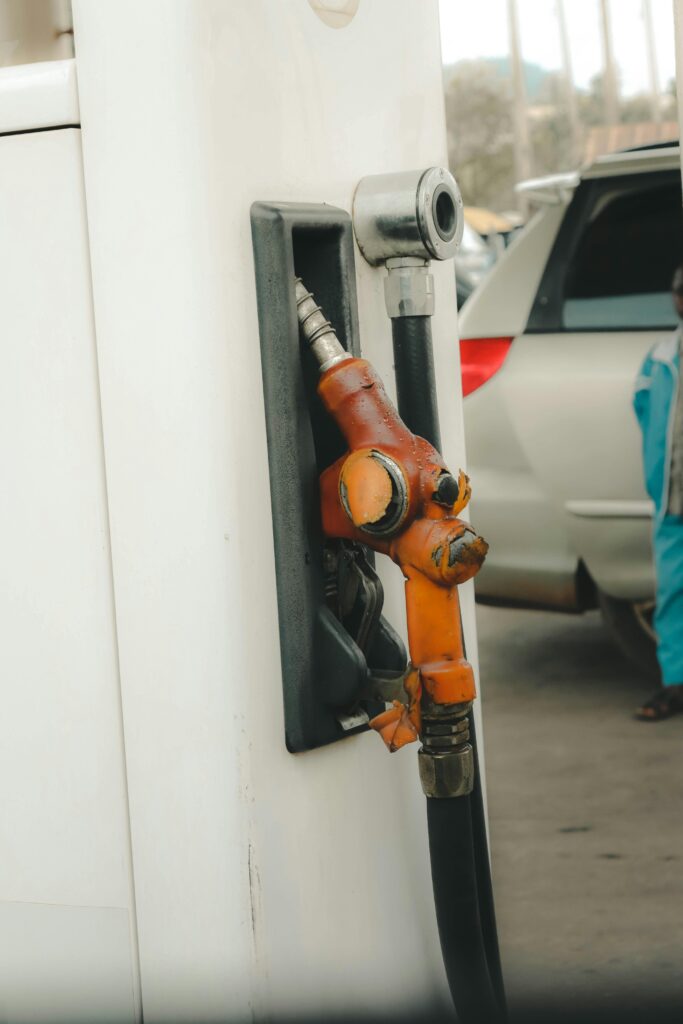
Executive Summary
Nigeria is an oil-producing nation that, paradoxically, remains deeply exposed to fuel prices at the pump. This brief examines how fuel prices in Nigeria function as a foundational pillar of price-setting across the economy, influencing logistics, manufacturing, food costs, and household budgets in equal measure. We close by drawing lessons from Saudi Arabia’s experience in anchoring domestic energy prices, arguing that a nation blessed with petroleum must find a way to translate that endowment into domestic price stability. The core finding is that fuel pricing in Nigeria is not only a welfare issue but also a central inflation-anchoring policy lever.
1. Nigeria: An Oil Giant Still Exposed to Fuel Prices
Nigeria’s economic identity is inseparable from petroleum. The country began producing crude oil in 1956, and by 2023 had grown to an estimated daily output of 1.5 million barrels per day, making it Africa’s largest oil producer (OPEC, 2023). Oil accounts for the overwhelming majority of the nation’s export revenue and a substantial share of government income. In this sense, Nigeria is not merely an oil-producing country—it is a derivative of oil. The commodity touches virtually every line of the national balance sheet, from fiscal revenue to foreign exchange earnings.
And yet, for all that petroleum wealth, Nigerians have historically paid among the most volatile fuel prices on the continent. Between May 2023 and late 2024, the retail price of premium motor spirit surged from ₦198 per litre to over ₦1,030 per litre, a rise in excess of 420% in under eighteen months (ThisDay, 2024). This is the central paradox this brief seeks to unpack: how can a country that sits on one of the world’s largest hydrocarbon reserves be so acutely exposed to the cost of the very product it produces?
2. Why Fuel Prices Set Every Other Price in Nigeria
Almost every Nigerian uses fuel, either directly or indirectly. This is not simply a statement about transportation. It is a structural observation about how energy costs propagate through the economy. Fuel is an input into nearly every sector, from transportation and manufacturing to agriculture and services. When the price of fuel moves, it does not stay in one place. It travels.
Academic research confirms this transmission dynamic. A 2025 study published in the Advanced Journal of Economics and Business Research employed a vector autoregression model to track how fuel price changes ripple across sectors. The findings were unambiguous: there is a strong and immediate pass-through of fuel price increases into general inflation, with particularly sharp effects in the transport and food sectors (Udo et al., 2025). The study further noted that lagged responses in other segments of the consumer basket suggest the inflationary impact persists well beyond the initial price shock.
SBM Intelligence’s The Price of Everything 2025 report documented this reality in concrete terms. Nigeria’s headline inflation rate reached 33.2% in 2024, a near thirty-year high, and the escalation in fuel prices was identified as a major driver of that inflationary pressure. Transportation costs more than doubled during the reporting period, and the knock-on effect was visible in staple food prices: local rice rose by 82%, noodles by 91.3%, and foreign rice by 73.7% (SBM Intelligence, 2025).
3. How Fuel Prices Spread Through the Economy: Two Channels
The mechanism through which fuel prices reshape the broader economy operates through two principal channels: logistics and production costs.
Logistics and Distribution. Nigeria’s economy depends heavily on road transportation for the movement of goods and people. When fuel prices rise, logistics costs rise with them, and those costs do not stay with the transporter. They are passed on to wholesalers, then to retailers, and ultimately to the consumer. This is especially acute in the food supply chain, where produce must travel long distances from farm to market. As noted in the econometric literature, the country’s underdeveloped infrastructure and limited energy alternatives mean that these transmission shocks tend to be both swift and severe (Udo et al., 2025).
Production and Manufacturing Costs. For producers in the consumer goods sector, fuel is not just something that moves their products; it is something that powers their factories. Manufacturers across food processing, beverages, textiles, and pharmaceuticals rely on diesel generators and petroleum-based energy inputs to sustain operations. When fuel prices spike, production costs climb accordingly. Businesses face a difficult choice: absorb the additional expense and compress margins, or pass it on to consumers through higher shelf prices. In practice, most do the latter (ActionAid Nigeria, 2024).
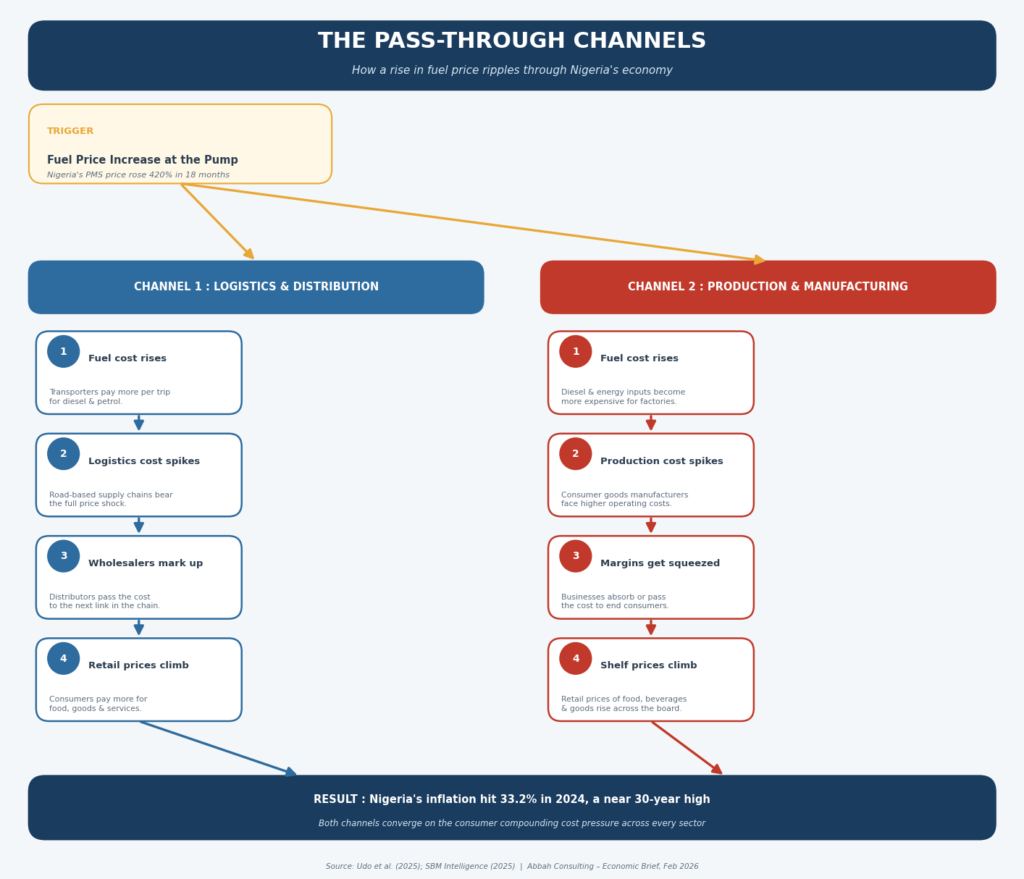
This infographic illustrates how a rise in fuel prices transmits through two key channels: logistics and distribution, and production and manufacturing, ultimately compounding cost pressures on Nigerian consumers. Both pathways converge, contributing to the near 30-year inflation high of 33.2% recorded in 2024.
4. What Nigeria Can Learn from Saudi Arabia on Fuel Price Stability
If the preceding analysis raises a question, it is this: what does it look like when an oil-rich country gets this right? The Kingdom of Saudi Arabia offers an instructive, if imperfect, example.
For decades, Saudi Arabia maintained some of the lowest fuel prices in the world through a system of generous government subsidies. Between 2010 and the mid-2010s, gasoline prices were held at around SAR 0.45 per litre for 91-octane fuel and remained unchanged for years, providing an extraordinary degree of domestic price stability. The cost of this stability was high, with total energy subsidies peaking at approximately $85 billion in 2012, representing roughly 11% of the country’s GDP (Gasim & Matar, 2023). But the economic logic was deliberate: by insulating citizens and businesses from global oil price volatility, the Kingdom kept domestic inflation low, reduced the cost burden on manufacturers, and sustained consumer purchasing power.
Saudi Arabia has since begun a phased reform of its subsidy regime, raising prices incrementally beginning in 2015 as part of its Vision 2030 diversification agenda. Critically, however, even after those reforms, Saudi fuel prices have remained well below global averages. As of 2025, gasoline still costs roughly half the international rate, and the government introduced a price cap mechanism in 2021 specifically to prevent domestic costs from rising too sharply (Darb, 2025). The Kingdom has also paired its subsidy adjustments with targeted social transfers, the Citizen Account programme, to cushion any impact on lower-income households (IMF, 2025).
The contrast with Nigeria is stark. While Saudi Arabia has treated domestic fuel pricing as a matter of national economic strategy managed, deliberate, and cushioned, Nigeria’s fuel pricing has been shaped more by external forces (exchange rate depreciation, global crude markets) and abrupt policy shifts (subsidy removal) than by a coherent anchor. The result is an economy in which every price, from a loaf of bread to a bus fare, is exposed to the volatility of the pump.
5. Fuel Price Stability Is a Strategy, Not a Luxury
Fuel pricing is not a peripheral issue in the Nigerian economy. It is foundational. Every price in the system in agriculture, manufacturing, retail, and services takes its cue, directly or indirectly, from the cost of petroleum at the pump. A country that allows that price to swing freely and unpredictably is, in effect, choosing to allow instability to propagate across every sector of its economy.
Nigeria possesses the raw material to do better. With proven crude oil reserves of approximately 37.1 billion barrels and the recent commissioning of domestic refining capacity through the Dangote Refinery, the structural preconditions for anchored fuel prices in Nigeria are, for the first time in decades, within reach (Raifu & Afolabi, 2024).
The question is no longer whether Nigeria can stabilise the price of fuel at the pump. It is whether the country will choose to treat that stability as the economic strategy it has always been.
References
ActionAid Nigeria. (2024). ActionAid Nigeria demands immediate action on fuel price increases and calls for economic reform. ActionAid Nigeria. https://nigeria.actionaid.org/news/2024/actionaid-nigeria-demands-immediate-action-fuel-price-increases-calls-economic-reform
Darb. (2025). Fuel price trends in Saudi Arabia (2010–2025). Darb Pay. https://darbpay.com/en/blog/fuel-price-trends-in-saudi-arabia-2010-2025/
Gasim, A. A., & Matar, W. (2023). Revisiting energy subsidy calculations: A focus on Saudi Arabia. The Energy Journal, 44(1). https://journals.sagepub.com/doi/10.5547/01956574.44.1.agas
International Monetary Fund. (2025). Saudi Arabia: 2025 Article IV consultation — Staff report. IMF Country Report No. 25/223. https://www.imf.org/en/publications/cr/issues/2025/08/02/saudi-arabia-2025-article-iv-consultation-press-release-and-staff-report-569252
OPEC. (2023). Annual statistical bulletin. Organisation of the Petroleum Exporting Countries. https://www.opec.org/annual-statistical-bulletin.html
Raifu, I. A., & Afolabi, J. A. (2024). Simulating the inflationary effects of fuel subsidy removal in Nigeria: Evidence from a novel approach. Energy Research Letters, 5(4). https://doi.org/10.46557/001c.94368
SBM Intelligence. (2025). The price of everything 2025. SBM Intelligence Research. Referenced via Proshare.
ThisDay. (2024). From ₦198 to ₦1,300: The over 420% alarming surge of fuel prices in 18 months. ThisDay Live. https://www.thisdaylive.com/index.php/2024/10/21/from-n198-to-n1300-the-over-420-alarming-surge-of-fuel-prices-in-18-months/Udo, S. S., Abang, S., & Salamat, A. U. (2025). Evaluating the inflationary consequences of fuel subsidy removal: An econometric approach to price transmission in Nigeria. Advanced Journal of Economics and Business Research, 13(2), 23–50. https://doi.org/10.5281/zenodo.15649951
Disclaimer: This economic brief was independently produced by Abbah Consulting for analytical and educational purposes. It does not represent a commissioned study, government mandate, or advisory engagement.
Written by: Abbah Mohammed – Business consultant & Investment Manager
(writes about capital, strategy, and the ideas shaping how businesses and markets evolve at the intersection of data, investment, and strategic thinking.)
Read More Here