

How the City of Winnipeg updated its permitting and licensing infrastructure, and how I contributed to making it work.
| 9,716 NET NEW UNITS, 2 YEARS | 1,046 AFFORDABLE UNITS PERMITTED | 1,040 DOWNTOWN UNITS, 2025 | 50+ PERMIT TYPES ONLINE |
Ways Permits Online 2.0 Fixed the System
A Crisis That Spans Continents and Cul-de-sacs
Housing is a global issue. In most cities, the problem is not a shortage of homes; it is that homes are not evenly distributed. Canada is no different, and Winnipeg, a fast-growing, increasingly international city, is feeling it acutely.
So the City is doing something about it. In December 2023, Winnipeg partnered with the federal government through the Housing Accelerator Fund, a $4 billion national programme launched to speed up housing supply by funding exactly the kind of reforms cities like Winnipeg need: faster permitting, zoning changes, and digital upgrades. Winnipeg secured $122.4 million over four years, paid in four instalments of roughly $30.6 million each, tied to one condition: actually hit the targets. No milestone, no money. Of course, Winnipeg pulled it off.
The reforms targeted four root causes:
| Slow permit approvals | Manual or outdated processes |
| Restrictive zoning rules | Limited digital infrastructure |
The one I want to zoom in on is permitting and licensing, unglamorous, but consequential. No contractor picks up a tool without a licence. No home gets built without a permit. The efficiency of that approval process directly determines how fast housing gets built. Winnipeg has been digitising this for years through Permits Online, the public-facing portal, and AMANDA, the backend system used by City staff. What the Housing Accelerator Fund changed was the pace and scale of execution.
THE PROBLEM
Six Printed Copies. Months of Waiting.
To understand what Permits Online 2.0 changed, you first need to understand what it replaced.
To build in Winnipeg, you needed two approvals: a Development Permit, confirming the project fits the location, and a Building Permit, confirming the structure is safe. The bottleneck? You could not apply for the Building Permit until the Development Permit was fully approved. Sequential. Gate-locked. For most construction projects, that meant weeks or months of waiting before a single shovel hit the ground.
On top of that, applications had to arrive as six printed copies, physically routed across departments. Then came email, which was real progress; files moved in seconds instead of being carried down a hallway. But it brought two drawbacks. First, there was no unified format: some people sent PDFs, others sent PNG images, and architects sent CAD and BIM files like DWG, DXF, and DWF, so staff had to wrestle each submission open and re-key the data by hand. Second, you still had no visibility into where your file sat in the queue. Backlogs piled up. The city kept growing, and a system that nobody designed to be slow became slow through layers of institutional sediment accumulated at those bottlenecks.
THE FIX
Three Ways the System Was Fixed
The Permits Online upgrade worked through three distinct, reinforcing mechanisms. Each one targets a different layer of the system, and together they contributed to the housing outcomes Winnipeg went on to report.
MECHANISM 01
Lower Submissoion Friction
The City started moving permit submissions online in April 2024, one category at a time. Residential permits went digital by June 2024; commercial permits followed by December. By June 2025, the portal had been rebuilt from scratch as a cloud-based web app hosted on Microsoft Azure, mobile-first and fully accessible. By April 2026, roughly 50 permit types were end-to-end online. The result? Fewer abandoned applications, less manual data entry, and far fewer “just checking on my file” calls.
The portal also went beyond housing permits. Tradespeople can now sit licensing exams and pay renewal fees directly inside Permits Online, no forms, no cheques, no trip downtown. Same system, fewer barriers, more homes built.
MECHANISM 02
Fewer Handoffs, Shorter Path
Remember that sequential, gate-locked process in which the Building Permit could not proceed until the Development Permit was fully approved? That bottleneck is gone. As of October 2025, both permits run concurrently, are reviewed in parallel, not in a queue. Development applications moved fully online in November 2025, shareable instantly across departments instead of being physically routed, and the queueing problem that plagued the old system was substantially resolved. One structural change. Massive downstream effect.
MECHANISM 03
Better Operational Visibility
The AMANDA backend now processes all applications electronically and feeds live data directly into Permits Online’s public portal. The City publishes the time to completeness and to decision for building, development, and occupancy permits, updated weekly via linked Open Data tables. Does this speed up an individual approval? Not directly. But it creates accountability, sharpens triage, and builds the kind of feedback loop that compounds into real improvement over time.
THE OUTCOMES
When Good Permitting Follows, Housing Follows
Winnipeg did not just meet its Housing Accelerator Fund targets. It exceeded them, every single time. The numbers below are official figures from the City and CMHC, and they tell a clean story: fix the process, and the homes follow.
CITY OF WINNIPEG – HAF RESULTS
Housing Outcomes at a Glance – City of Winnipeg & CMHC, Dec 2025
| 4,307 PERMITTED UNITS, YEAR 1 HAF Target: 3,733 +15.4% above target | 9,716 NET NEW UNITS, 2 YEARS HAF Target: 8,521 +14% above target | 1,046 AFFORDABLE UNITS, 2 YEARS Min. 3-yr target: 931 Surpassed before Year 3 |
| 1,040 DOWNTOWN UNITS, 2025 No specific target 15-year high in Winnipeg | 1,008 UNITS WITH PERMITS ISSUED HAF grant projects: 10 First-round HAF grants | 590 AFFORDABLE IN HAF GRANTS Incl. 274 rent-geared Rent-geared-to-income |
HOUSING ACCELERATOR FUND, WINNIPEG
HAF Permitted-Unit Progress
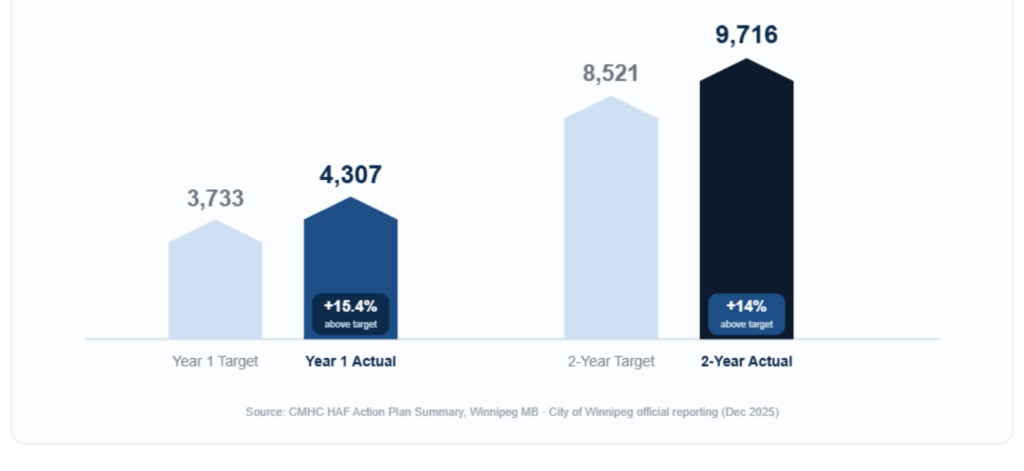
These results reflect the full HAF package: Permits Online 2.0 was the engine, but zoning reform, land assembly, and housing incentives were all part of the same push. And because every instalment of the $122.4 million agreement was tied to verified, reported progress, Winnipeg had to earn each tranche by actually hitting its targets. No delivery, no money. The digital permitting improvements were a direct part of making that happen.
MY CONTRIBUTION
AGILE BUSINESS ANALYST · CITY OF WINNIPEG · INNOVATION & TECHNOLOGY
I joined the City of Winnipeg in October 2025, right as Permits Online 2.0 was being introduced in full to the public. My role sat at the intersection of technology and people, making sure the system worked exactly the way it was designed to, for every person who needed to use it.
My core responsibility was validation and integration testing. I ran end-to-end tests across Permits Online 2.0 to confirm the new portal connected seamlessly with the AMANDA backend and matched the business workflows it was built to support. That meant functional testing across the Building Permit, Development Application, and CLIC (Customer Licensing, Information and Compliance) Exam Application modules, verifying that applicants could submit, track, and pay for permits without hitting errors or dead ends. The handoff between a public-facing portal and a backend case-management system is where most permitting platforms quietly fall apart. Getting that right was a big part of what I was there to do.
Alongside testing, I was responsible for accessibility and user experience compliance. I documented and escalated UI/UX issues, holding the platform to WCAG 2.1 AA standards under the Accessibility for Manitobans Act. I also standardised data presentation and data entries across the interface, replacing abbreviations with full descriptive terms, contributing to the data clarity and governance standards that the City’s public Open Data tables depend on.
To make the quality stick beyond launch, I built structured test cases, validation documentation, and testing procedures, living documents that give future testers a verified baseline to build on rather than starting from zero. After go-live, I managed the Post-Go-Live Enhancements tracker in Azure DevOps, writing change request descriptions, validating completed tasks, and maintaining the audit trail that connects real user feedback to real system improvements.
The result: permit technicians, developers, and homeowners could rely on a system that worked as described, for everyone it was built to serve. Spreadsheets into an app. That is the work.
WHAT COMES NEXT
The System Is Still Getting Better
Permits Online 2.0 is not a finished product. It is a living system. The roadmap ahead includes automated plan checking, video inspections, and self-service property searches. New permit types keep getting added, and the AMANDA integration makes further automation increasingly possible. Every improvement, however small, means time saved for builders and homes delivered sooner for families. Every milestone hit brings the next round of federal funding to keep the momentum going.
Here is the bigger point, though. When governments invest in the invisible machinery of permission, the permits, the licences, the approval workflows, real outcomes follow for real people. Homes get built. Families have somewhere to live. Cities grow in ways that are planned and safe. Administrative infrastructure is housing infrastructure. The work happening inside Winnipeg’s Innovation & Technology and PP&D departments is housing policy. It just happens to be written in code.
I arrived in Winnipeg in October 2025, a newcomer to this city, and I got to contribute, in my own consistent way, to systems that serve the people here. That means something to me.
The reward for goodness is goodness. That is my why.
Sources and Accuracy: Housing outcome figures are based on official City of Winnipeg Housing Accelerator Fund reporting and CMHC materials. The figures refer to construction-permitted housing units, which may be completed, under construction, or pending construction. Permits Online modernisation details are based on the City of Winnipeg’s public Permits Online and service improvement pages.
AUTHOR’S NOTE
I am Awwal Seghosime, an Agile Business Analyst at the City of Winnipeg. I sit between what the business needs and how to fulfil those needs with technology. On Permits Online 2.0, that meant being there during and after launch to make sure it worked the way it was meant to: validation and integration testing to confirm the system held together, user experience testing to keep access open to everyone, accessibility auditing and fixes, data governance and standardisation, system documentation, and post-launch tracking through Azure DevOps.
I want to tell you a quick story about a quiet piece of infrastructure: permitting and licensing. Moving it online has turbocharged how efficiently and quickly homes get delivered to Winnipeggers, and yes, I helped. Immerse yourself in infrastructure tech, and let me show you how a web app is helping deliver homes faster.
Awwal Seghosime
Agile Business Analyst, City of Winnipeg · Innovation & Technology
Read More Here