Dropbox made the cloud feel like a folder, turned down Apple and built a $2.5 billion business. Then the giants turned its core product into a free default. Here is what the Dropbox strategy teaches every founder building on someone else’s infrastructure, from San Francisco to Lagos.
What happens when the product that changed an industry becomes something the industry can copy?
That question sits at the heart of the Dropbox strategy story. Dropbox made file synchronisation feel effortless, listed on Nasdaq in March 2018 and now counts more than 700 million registered users. Yet revenue has been broadly flat for two years, and in May 2026 co-founder Drew Houston announced he would hand the CEO role to Ashraf Alkarmi after 19 years in charge. The product that defined a category is no longer the whole story.
Dropbox did not simply face competitors. It faced an ecosystem shift. For African founders building on foreign clouds, app stores and payment rails, that shift is the most important lesson in this Dropbox case study.
DROPBOX BY THE NUMBERS
- 700M+ registered users
- 18.19M paying users at 30 June 2026, a third straight quarter of growth
- $2.52B FY2025 revenue, down 1.1% year on year
- +0.9% Q2 2026 revenue growth, to $631.5 million
- 40.6% FY2025 non-GAAP operating margin
- $1.02B FY2025 unlevered free cash flow
Before Dropbox, moving files was manual work
Getting a file from one computer to another used to mean USB sticks, email attachments, FTP or an external drive. You copied, attached, sent, then hoped the latest version arrived.
Dropbox replaced that ritual with one rule: save once, and every device updates automatically. It did not invent the cloud. It made the cloud feel like a folder on your computer, and that simple idea became the foundation of the early Dropbox strategy.
Six reasons the product clicked
- Simplicity: one folder, no setup ritual.
- Automatic sync: changes spread without a manual step.
- Cross-device access: the same files on every screen.
- Folder familiarity: built on a metaphor people already knew.
- Easy sharing: a link replaces the attachment.
- Low learning curve: nothing new to learn before getting value.
How the Dropbox strategy built growth into the product
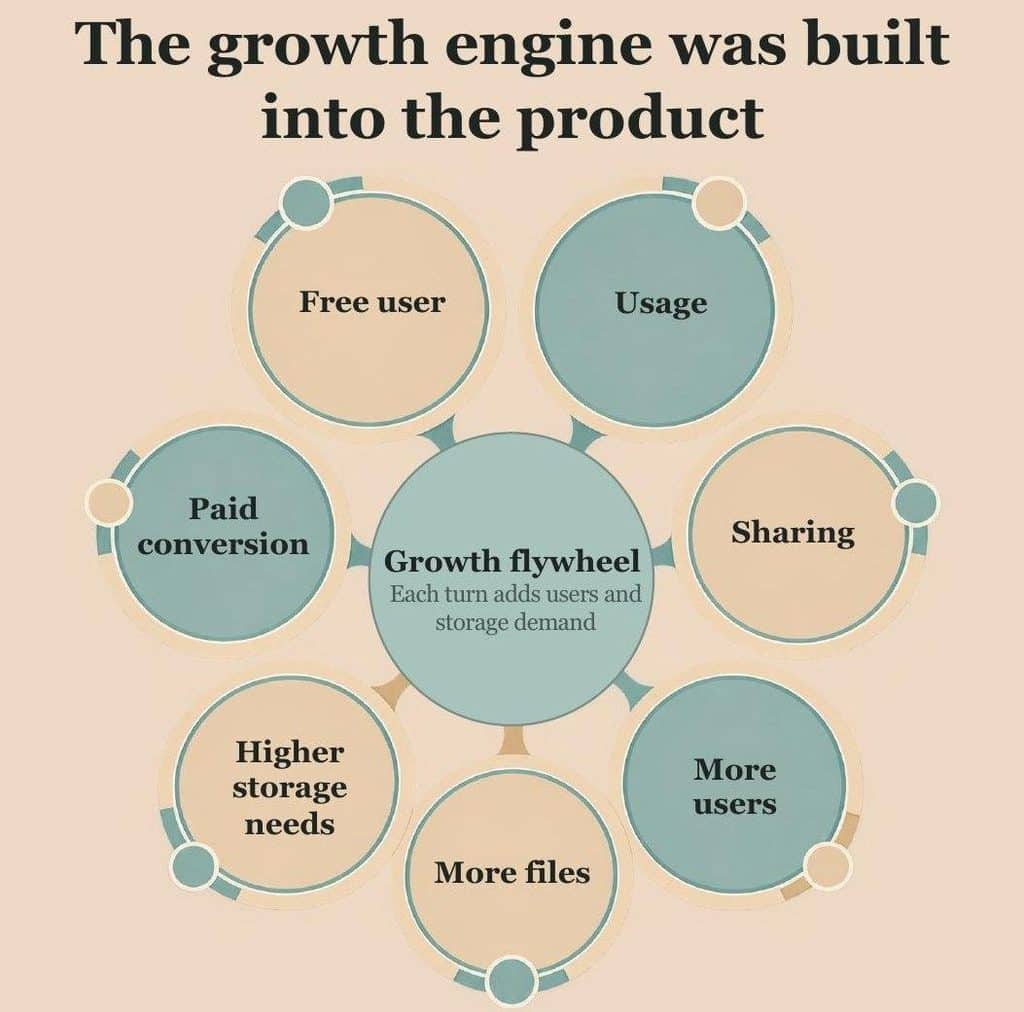
The early Dropbox strategy did not depend on expensive advertising. Distribution lived inside the product itself.
A free user stored files and shared folders. Every share was a referral that brought in more users, who added more files. Growing libraries created higher storage needs, which pushed people towards paid plans. Each turn of that flywheel added users and storage demand at almost no onboarding cost.
The Steve Jobs moment: a feature, not a product
In December 2009, Steve Jobs invited co-founders Drew Houston and Arash Ferdowsi to Apple’s Cupertino office. Forbes reported in 2011 that Jobs made a pitch worth nine figures. Houston cut it short: he wanted to build a big company and was not selling. Dropbox declined.
Jobs told them Apple would go after their market anyway. As Houston told Forbes, Jobs called Dropbox a feature, not a product. It is Houston’s recollection rather than a transcript, but the strategic point is hard to miss.
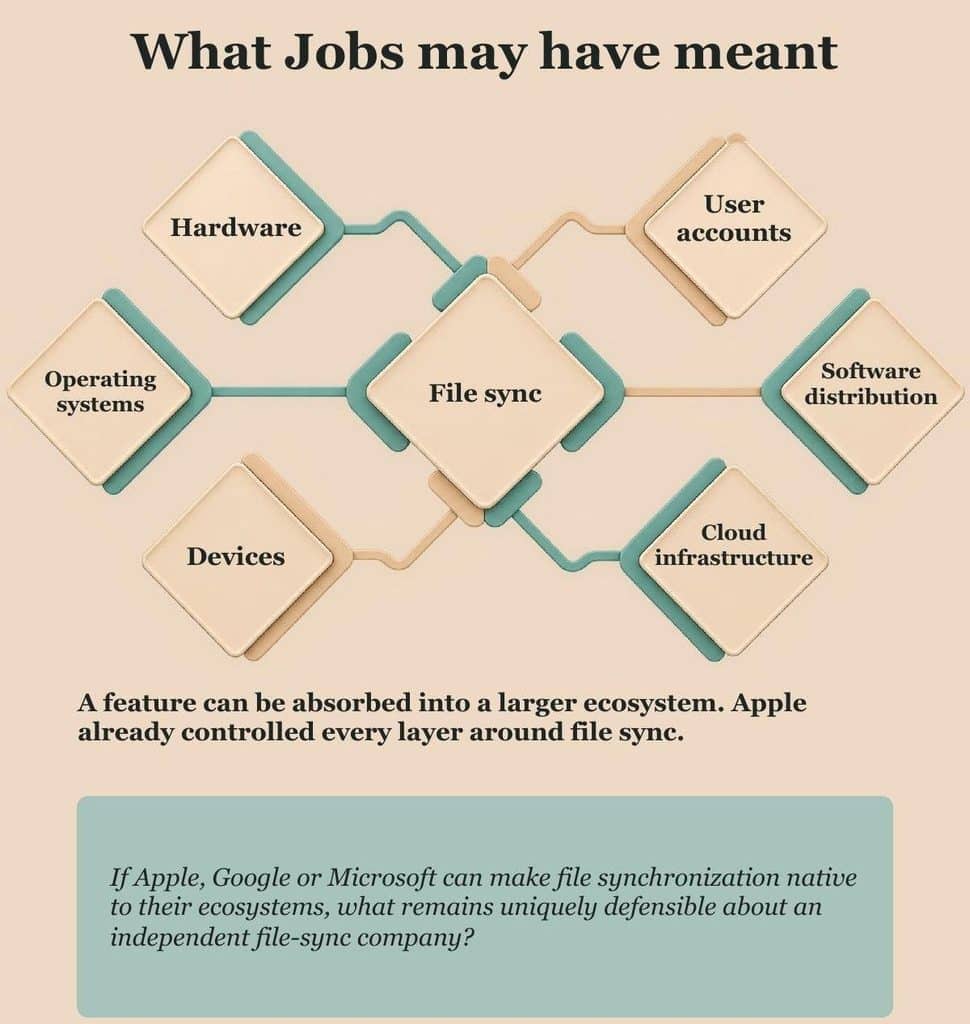
A feature can be absorbed into a larger ecosystem. Apple already controlled every layer around file sync.
Apple owned the hardware, the operating systems, the devices, user accounts, software distribution and cloud infrastructure. File sync sat in the middle of all six. That raised the question that would shape the Dropbox strategy for the next decade: if Apple, Google or Microsoft can make sync native, what remains defensible about an independent sync company?
Then the giants arrived
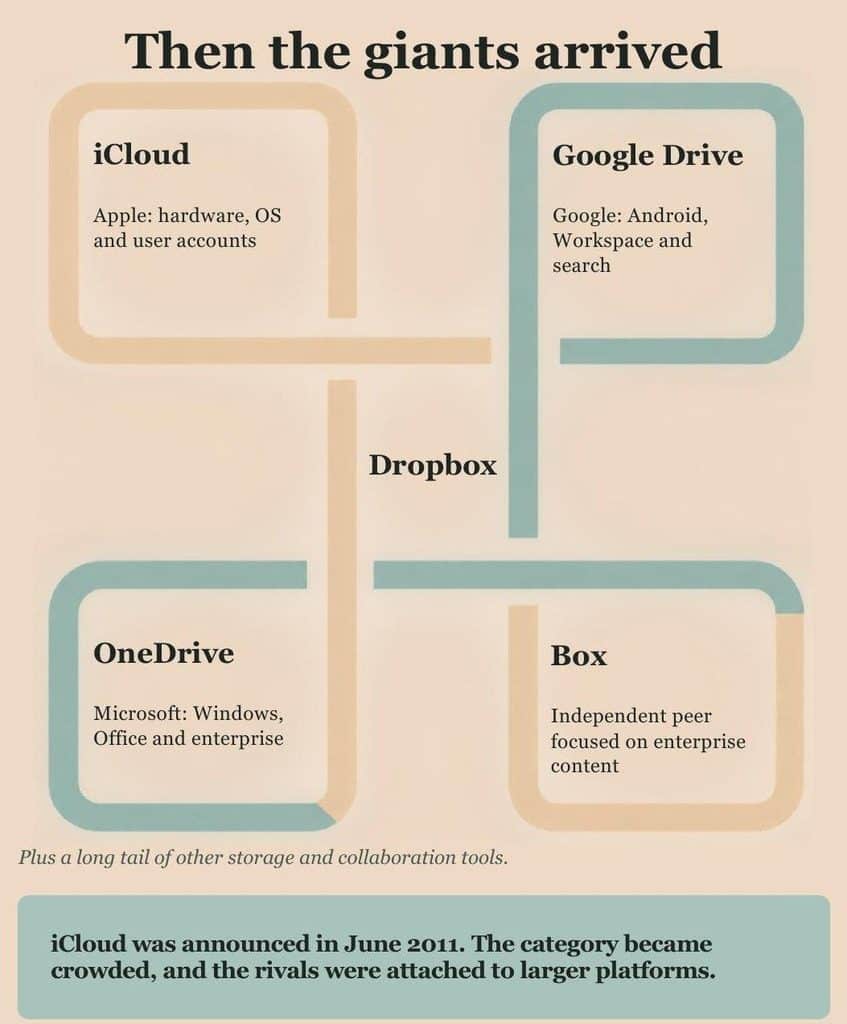
Apple announced iCloud in June 2011, at what would be Jobs’s final keynote. Google Drive launched in 2012, and Microsoft’s SkyDrive, later renamed OneDrive, was pulled ever deeper into Windows and Office. Each rival was attached to a much larger platform:
- iCloud: Apple’s hardware, operating system and user accounts.
- Google Drive: Android, Workspace and search.
- OneDrive: Windows, Office and enterprise.
- Box: an independent peer focused on enterprise content.
Add a long tail of storage and collaboration tools, and the category became crowded fast. The Dropbox strategy had to change.
The real problem was not storage
Cloud storage became a commodity. Four forces drove it:
- Bundling: large technology companies include storage in broader offers.
- Expectation: users now expect sync to simply exist.
- Embedding: storage lives inside productivity ecosystems.
- Switching costs: they come from the ecosystem, not from storage alone.
Value moved up the chain, from storage to sync to collaboration to workflow. If everyone offers storage, the margin has to come from somewhere else. That question forced the next chapter of the Dropbox strategy.
The Dropbox strategy pivot: from storage to workflow
Dropbox saw the squeeze coming and moved up the value chain:
- 2015: Dropbox Paper announced, a collaborative document editor.
- 2019: HelloSign acquired for about $230 million, later renamed Dropbox Sign.
- 2021: DocSend acquired for $165 million, adding secure document sharing and tracking.
- 2022: FormSwift acquired for $95 million, extending into forms and document workflows.
- 2024 to 2025: AI scheduling tool Reclaim.ai acquired in August 2024, and Dash, an AI-powered search and knowledge product, brought to market.
The promise shifted from “store and synchronise my files” to “help me create, organise, collaborate on and manage my work.” Storage is easy for platforms to bundle. Workflow creates deeper relationships and higher switching costs.
Not every bet paid off. Dropbox significantly reduced its investment in FormSwift at the start of 2025 and plans to wind it down by the end of 2026. Excluding FormSwift, FY2025 revenue grew just 0.2%. Moving up the value chain is a strategy, not a guarantee.
Network effects versus ecosystem effects
A network effect means more users make a service more valuable. An ecosystem effect means more products make the whole platform more valuable.
Dropbox built strong user-driven distribution and collaboration effects, but they live inside one product. Apple, Google and Microsoft compound effects across many products an independent company does not own. The device, the account and the app store are already there, so the platform starts with the default.
That is the core tension in the Dropbox strategy: Dropbox benefits from being platform-neutral, while platform owners benefit from making neutrality less necessary.
Was Dropbox a failure?
No. Losing category dominance is not the same as failing to build a durable business.
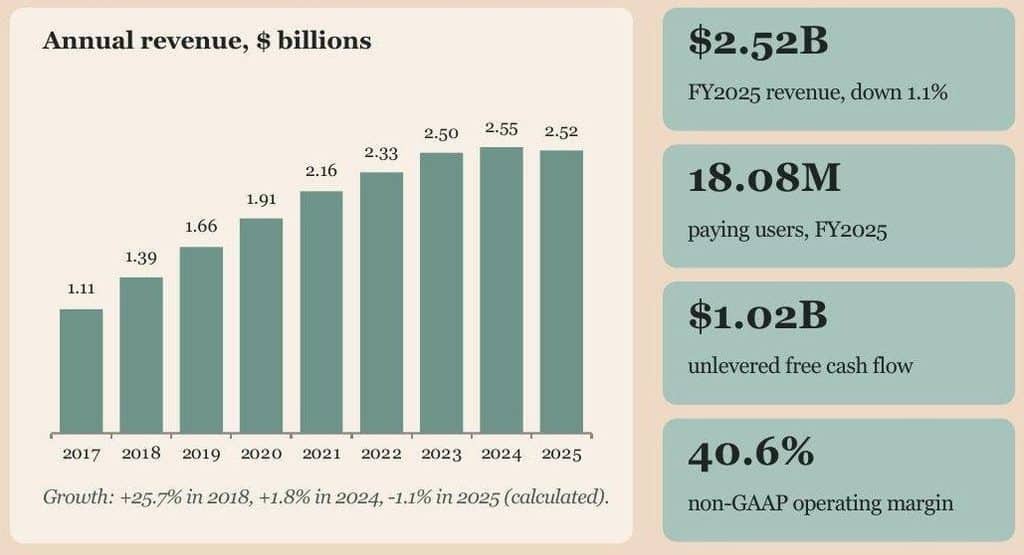
Revenue grew from $1.11 billion in 2017 to a peak of $2.55 billion in 2024, before slipping to $2.52 billion in 2025. Last year the company posted a 40.6% non-GAAP operating margin, generated over $1 billion in unlevered free cash flow and repurchased about $1.7 billion of its own shares.
That is a profitable, cash-generative business. It is also a business whose growth has flattened: paying users slipped from 18.22 million at the end of 2024 to 18.08 million at the end of 2025.
The 2026 picture is slightly brighter. Revenue grew 0.8% in the first quarter and 0.9% in the second, and paying users climbed back to 18.19 million by June, the third consecutive quarter of growth. New co-CEO Ashraf Alkarmi, who ran the core business before his promotion, is betting on AI-driven workflows. Both things are true at once, and judging the Dropbox strategy fairly means holding both.
5 lessons from the Dropbox strategy
Strip away the dates and the deals, and the Dropbox strategy leaves five lessons that apply to any technology company.
- Product-market fit is not permanent. Fit is a relationship with a market, and the market keeps moving.
- A great product can become a commodity. When rivals can match the core function, differentiation has to come from somewhere else.
- Platform owners can change the landscape overnight. A native default on the device can outweigh a better standalone feature set.
- Independence without defensibility gets expensive. You keep control, but you must fund your own moat.
- The next advantage comes from moving up the value chain. From storage towards workflow, data and ecosystem.
What the Dropbox strategy means for African tech
Now ask the same question closer to home: what happens when an African startup builds a great product on top of someone else’s infrastructure?
Most Nigerian and African startups rent critical layers: foreign cloud platforms, app stores, payment infrastructure, AI APIs, operating systems, identity infrastructure and distribution platforms.
Renting is not a mistake. Building on existing infrastructure means faster launch, lower capital needs and mature tools. Owning strategic infrastructure brings more control and leverage, but requires more capital and is slower. Startups need not build everything. The question is which layers to rent and which to own.
A fintech that relies on one payment rail, one app store and one AI provider can wake up to find a platform owner has shipped its core feature as a free default. A startup that owns its data, its customers’ workflow or a regulated layer is far harder to absorb. In Nigeria, rules such as the Nigeria Data Protection Act 2023 can turn careful local data handling into exactly that kind of ownable layer.
The 5-Layer Defensibility Test
✓ Product: Is the product genuinely differentiated?
✓ Distribution: Can customers be acquired efficiently?
✓ Data: Does usage create proprietary information or intelligence?
✓ Workflow: Does the product become embedded in how customers work?
✓ Ecosystem: Does the company control or join an ecosystem that reinforces its position?
The more layers a company owns, the harder it becomes to reduce it to a feature.
Final thought: was Jobs right?
Partly. File sync has become a feature that every platform now ships by default. But Dropbox refused to be only that feature, built a business that still earns billions and, under new leadership, is now betting its next chapter on AI-powered work tools, not storage.
The biggest threat to a great product may not be a better product. It may be a larger ecosystem. The Dropbox strategy story is a case study in how technology markets move from products to platforms to ecosystems, and every founder should know which stage their market is in.
Renting the right layers, owning the right ones
Cloud Technology Hub helps businesses design cloud, data and infrastructure they control, so your product is never one platform update away from becoming a feature. Talk to our team about your architecture.
Speak to our team at info@technohub.cloud. TALK
Leave a comment and Read More Here
By Abbah Mohammed, Lead Consultant, Abbah Consulting